How to type Greek with this keyboard
Choose a mode with the tabs above the text box:
- Phonetic: type Greek with English letters and they turn into Greek as you type. eucharistw' becomes ευχαριστώ, ps becomes ψ and th becomes θ. Add ' after a vowel for the accent: a' gives ά. See the table below.
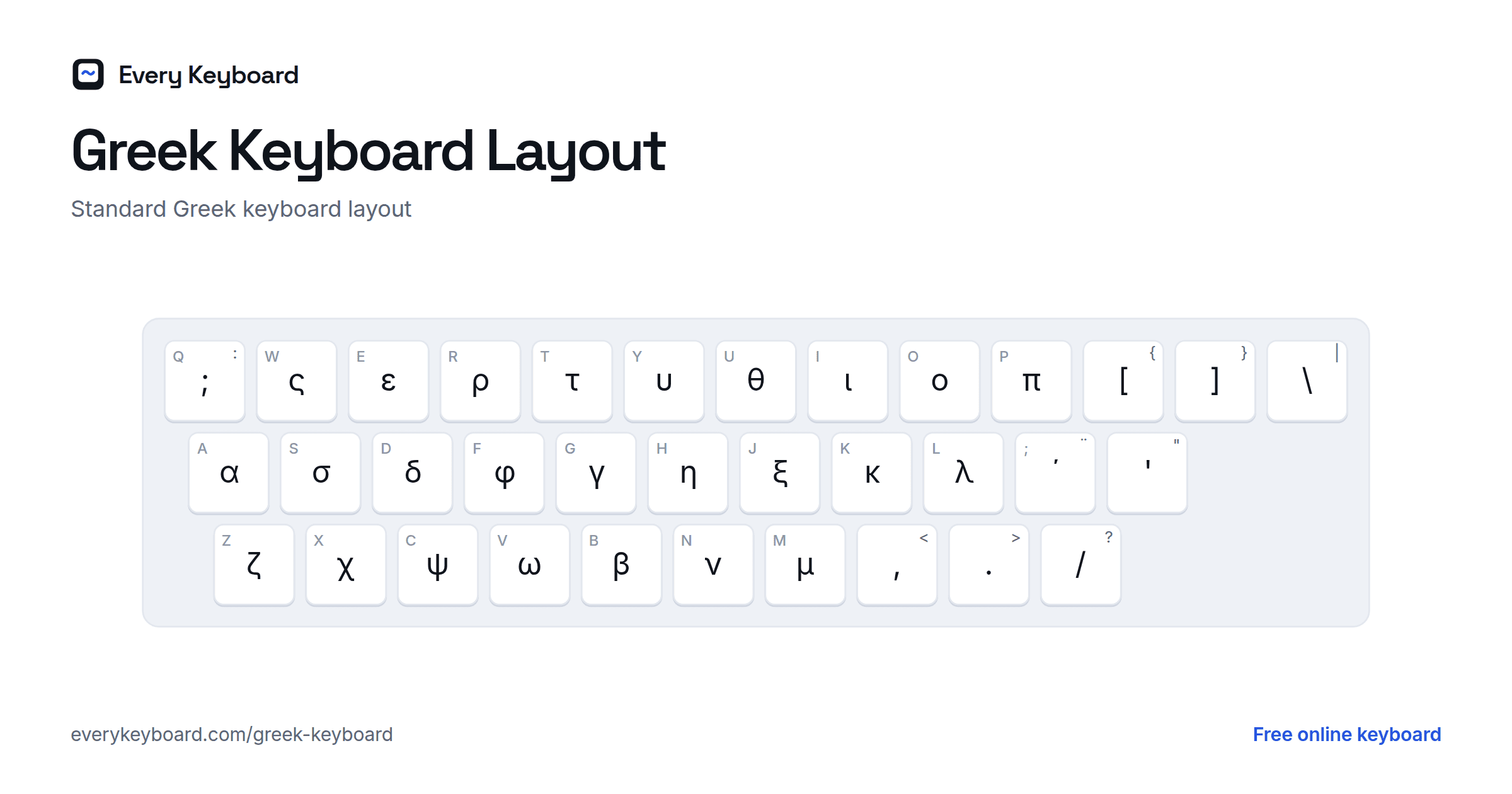
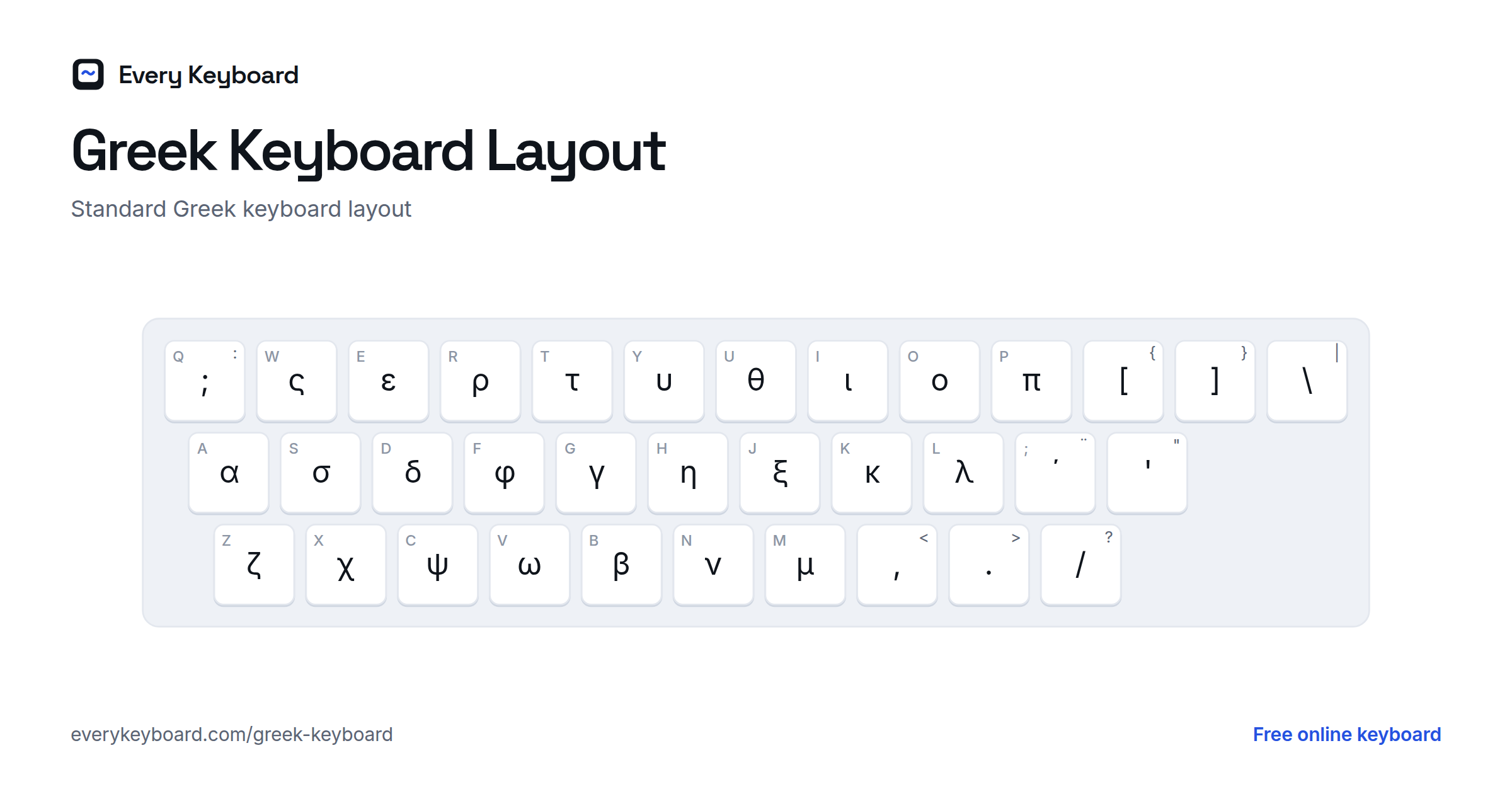
- Greek (standard): the layout used in Greece. It's easy to learn because most letters are on the English key with a similar sound: A types α, B types β, G types γ, P types π. The rest are on nearby keys: U is θ, J is ξ, C is ψ, V is ω, X is χ and H is η.
- Alphabet: all 24 letters in order, plus ς. Click a letter to add it. Press Shift or Caps for capitals. Handy if you only need a few Greek letters for math, science or a fraternity name.
For accents, press ; and then a vowel (ά έ ή ί ό ύ ώ), or Shift+; and then ι or υ for ϊ ϋ, just like on a real Greek keyboard. You can also click the accented letters above the keyboard. Type σ everywhere: it becomes ς automatically at the end of a word. Press Esc to switch between Greek and normal English typing.
Typing Greek with English letters
In Phonetic mode, type these letters and they turn into Greek as you go. Capitals work too: Th gives Θ. Because th, ph and kh make one letter, type j for η after t, p or k: tjn gives την. σ becomes ς by itself at the end of a word.
| Greek | Type |
|---|---|
| α β γ δ ε ζ ι κ λ μ ν ξ ο π ρ σ τ υ φ ω | a b/v g d e z i k l m n x o p r s t u/y f w |
| η | j (or h) |
| θ | th |
| φ | ph |
| χ | kh / ch |
| ψ | ps |
| ά έ ή ί ό ύ ώ | a' e' j' i' o' u' w' |
| ϊ ϋ | i" u" |
| ; (Greek question mark) | ? |
| · (ano teleia) | ; |
Greek keyboard layout
This is the standard Greek layout used on Windows, Mac and Linux. The number row is the same as on a US keyboard. The small letter on each key is the English key in the same place.
A few keys differ from what you might expect:
- Q types ;, the Greek question mark, and Shift+Q types :.
- W types ς, the final sigma. The regular σ is on S.
- The ; key (next to L) is a dead key: it types nothing by itself and adds an accent to the next vowel. With Shift it adds the dialytika (two dots).
The Greek alphabet (Greek letters)
The Greek alphabet has 24 letters. The table shows each letter in capital and small form, its English and Greek name, how it sounds in modern Greek, the usual Latin spelling (the ELOT 743 standard, also used for Greek passports) and what the letter commonly stands for in math and science.
| Letter | Name | Sound | Latin | Math and science |
|---|---|---|---|---|
| Α α | Alpha (άλφα) | a as in father | a | α: angles, alpha particles, significance level in statistics |
| Β β | Beta (βήτα) | v as in van | v | β: beta particles, regression coefficients |
| Γ γ | Gamma (γάμμα) | a soft, throaty g; like y in yes before e and i sounds | g | γ: gamma rays, the Lorentz factor. Γ: the gamma function |
| Δ δ | Delta (δέλτα) | th as in this | d | Δ: change in a value (Δx), the discriminant. δ: a small change, the Kronecker delta |
| Ε ε | Epsilon (έψιλον) | e as in met | e | ε: a small positive number, permittivity (ε₀) |
| Ζ ζ | Zeta (ζήτα) | z as in zoo | z | ζ: the Riemann zeta function, damping ratio |
| Η η | Eta (ήτα) | ee as in see | i | η: efficiency, viscosity |
| Θ θ | Theta (θήτα) | th as in think | th | θ: angles. Θ: big-Theta in algorithm analysis |
| Ι ι | Iota (γιώτα) | ee as in see | i | Rarely used as a symbol |
| Κ κ | Kappa (κάππα) | k | k | κ: curvature, thermal conductivity, Cohen's kappa |
| Λ λ | Lambda (λάμδα) | l | l | λ: wavelength, eigenvalues, lambda calculus. Λ: the cosmological constant |
| Μ μ | Mu (μι) | m | m | μ: the micro- prefix (μm, μg), a population mean, coefficient of friction |
| Ν ν | Nu (νι) | n | n | ν: frequency, degrees of freedom |
| Ξ ξ | Xi (ξι) | ks as in box | x | ξ: random variables, coordinates |
| Ο ο | Omicron (όμικρον) | a short o, as in port | o | Rarely used, since it looks like o |
| Π π | Pi (πι) | p | p | π: 3.14159…, the circle constant. Π: product of a sequence |
| Ρ ρ | Rho (ρο) | a tapped or rolled r | r | ρ: density, resistivity, correlation coefficient |
| Σ σ ς | Sigma (σίγμα) | s as in sun | s | Σ: summation. σ: standard deviation, stress |
| Τ τ | Tau (ταυ) | t | t | τ: torque, a time constant, τ = 2π |
| Υ υ | Upsilon (ύψιλον) | ee as in see | y | Rarely used, since it looks like v |
| Φ φ | Phi (φι) | f | f | φ: the golden ratio (1.618…), angles, Euler's totient. Φ: magnetic flux |
| Χ χ | Chi (χι) | ch as in Scottish loch | ch | χ: the chi-squared test (χ²), susceptibility |
| Ψ ψ | Psi (ψι) | ps as in lapse | ps | ψ: the wave function in quantum mechanics, a symbol for psychology |
| Ω ω | Omega (ωμέγα) | a short o, same as omicron | o | Ω: ohm, the unit of resistance. ω: angular frequency |
Modern Greek pronunciation differs from the ancient pronunciation used in English names of the letters. For example, β is "v" today, and η, ι and υ all sound like "ee". Scholarly transliterations of ancient Greek use b for β, ē for η, u or y for υ, kh for χ and ō for ω.
Typing Greek symbols for math and science
If you need a Greek letter in another app, copy it from this page or use a shortcut. In Microsoft Word, type the Unicode code and press Alt+X. On Windows, some letters have Alt codes: hold Alt and type the number on the number pad. In HTML, use the named entity.
| Symbol | Name | Word: code + Alt+X | Windows Alt code | HTML |
|---|---|---|---|---|
| α | alpha | 03B1 | Alt+224 | α |
| β | beta | 03B2 | β | |
| γ | gamma | 03B3 | γ | |
| Δ | capital delta | 0394 | Δ | |
| δ | delta | 03B4 | Alt+235 | δ |
| ε | epsilon | 03B5 | Alt+238 | ε |
| θ | theta | 03B8 | θ | |
| λ | lambda | 03BB | λ | |
| μ | mu | 03BC | μ | |
| π | pi | 03C0 | Alt+227 | π |
| Σ | capital sigma | 03A3 | Alt+228 | Σ |
| σ | sigma | 03C3 | Alt+229 | σ |
| τ | tau | 03C4 | Alt+231 | τ |
| φ | phi | 03C6 | Alt+237 | φ |
| Ω | capital omega | 03A9 | Alt+234 | Ω |
| ω | omega | 03C9 | ω |
The Alt codes come from an old DOS character set, so only these letters have one. Alt+230 gives the micro sign µ, which looks like μ, and Alt+225 gives the German ß, which is often used as a stand-in for β but is a different character. On a Mac, Option+P types π, Option+Z types Ω and Option+M types µ. For any other letter, open the Character Viewer with Control+Command+Space and search for its name.
Greek accents: tonos and dialytika
Modern Greek is written in the monotonic system, official since 1982. It uses just two marks:
- The tonos (΄) marks the stressed vowel in every word of two or more syllables: καλημέρα, ευχαριστώ. Changing the accent can change the meaning, as in πότε (when) and ποτέ (never).
- The dialytika (¨) shows that two vowels are said separately instead of as one sound. In προϊόν (product) you say pro-i-on; without the dots, οι would be read as a single "ee" sound. Sometimes a letter has both marks: ΐ, ΰ.
| Letter | Example | Type on a Greek keyboard |
|---|---|---|
| ά Ά | άνθρωπος (person) | ; then α |
| έ Έ | έλα (come) | ; then ε |
| ή Ή | ήλιος (sun) | ; then η |
| ί Ί | σπίτι (house) | ; then ι |
| ό Ό | όχι (no) | ; then ο |
| ύ Ύ | νύχτα (night) | ; then υ |
| ώ Ώ | ώρα (hour) | ; then ω |
| ϊ Ϊ | προϊόν (product), Ταϊλάνδη (Thailand) | Shift+; then ι |
| ϋ Ϋ | προϋπόθεση (condition) | Shift+; then υ |
| ΐ | ταΐζω (I feed) | ΐ button |
| ΰ | rare | ΰ button |
Words written in ALL CAPITALS usually drop the tonos (ΚΑΛΗΜΕΡΑ), but a capital at the start of a word keeps it (Άρης). Older and religious texts use the polytonic system with breathings and several accents. Windows and Mac both include a Greek Polytonic keyboard for that.
Greek keyboards can also type ΐ and ΰ, but the key combination differs between systems, so this page gives them their own buttons.
Final sigma (ς)
Sigma is the only Greek letter with two lowercase shapes: σ at the start or middle of a word and ς at the end, as in σεισμός (earthquake) or Σωκράτης. The capital is Σ in every position. On a Greek keyboard, ς has its own key (W).
On this page you don't need to think about it: in Greek (standard) mode, type σ and it turns into ς as soon as you end the word with a space or punctuation. If you keep typing the word, it turns back into σ. A lone σ, and σ before an apostrophe (σ' αγαπώ), are left alone.
How to add a Greek keyboard to your device
Windows
Settings → Time & language → Language & region → Add a language → Greek. This adds the standard Greek keyboard shown above. Switch between keyboards with Windows+Space or Alt+Shift.
Mac
System Settings → Keyboard → Text Input → Edit → + → Greek. Choose "Greek" for modern Greek or "Greek Polytonic" for ancient texts. Switch with Control+Space or the Globe key.
iPhone and iPad
Settings → General → Keyboard → Keyboards → Add New Keyboard → Greek. Tap the globe key to switch. Press and hold a vowel to pick an accented version.
Android
In Gboard, open Settings → Languages → Add keyboard → Greek. Tap the globe key or hold the space bar to switch. Press and hold a vowel for accents.
Chromebook
Settings → Device → Keyboard and inputs → Input settings → Add input methods → Greek. Switch with Ctrl+Space.
Frequently asked questions
How do I type Greek letters without a Greek keyboard?
Use this page. In Phonetic mode you type with English letters and they turn into Greek: a is α, b is β, th is θ, ps is ψ, and a' is ά. In Greek (standard) mode your keys work like a real Greek keyboard. For single letters, open the Alphabet tab and click them, then press Copy and paste wherever you need them.
How do I type accents (tonos) in Greek?
On a Greek keyboard the accent is a dead key on the ; key, next to L. Press ; and then the vowel: ; then α gives ά. For the two dots (dialytika), press Shift+; and then ι or υ: ϊ, ϋ. This page works the same way, and there are buttons for every accented vowel above the keyboard.
What is final sigma (ς)?
Sigma has two lowercase forms: σ inside a word and ς at the end of a word, as in λόγος. On a Greek keyboard ς is on the W key. On this page you can simply type σ everywhere: it changes to ς when you finish the word with a space or punctuation.
How do I type π, Σ, μ and other Greek symbols in Word?
In Word, type the letter's Unicode code and press Alt+X: 03C0 then Alt+X gives π. In a Word equation you can also type \pi or \alpha and a space. On Windows some letters have Alt codes (Alt+227 is π), and on a Mac Option+P types π and Option+Z types Ω. The table above lists the codes.
Why does the Greek question mark look like a semicolon?
Because it is one. Greek uses ; to end a question, as in Τι κάνεις; (How are you?). Unicode has a separate Greek question mark (U+037E), but it is treated as the same character as the semicolon, and most Greek text simply uses the ordinary ;. The Greek semicolon is the raised dot · (ano teleia).
Is my text private?
Yes. Everything runs in your browser. Your draft is kept on your own device so it survives a refresh, and it's never uploaded.