How to type in Pashto with this keyboard
Choose a layout with the tabs on the keyboard:
- Pashto (standard): the Pashto (Afghanistan) layout that comes with Windows, the one printed on Pashto keyboards. Your keys type Pashto right away. Use it if you already know the layout or want to learn it.
- Phonetic: each English key types the Pashto letter that sounds like it, so you can type without learning a new layout. B types ب, L types ل, and Shift gives a related letter: Shift+T is ټ.
- Alphabet: every letter in order with a Latin label, plus the vowel marks and Pashto digits, to click one by one.
Try the Phonetic layout: P X T W gives پښتو (Pashto), and S L A M gives سلام. The buttons on the keyboard add the Pashto letters and punctuation. Open Vowel marks for zwar, zwarakay, zer, pekh and the other marks. Press Esc to switch between Pashto and normal English typing.
Standard Pashto keyboard layout
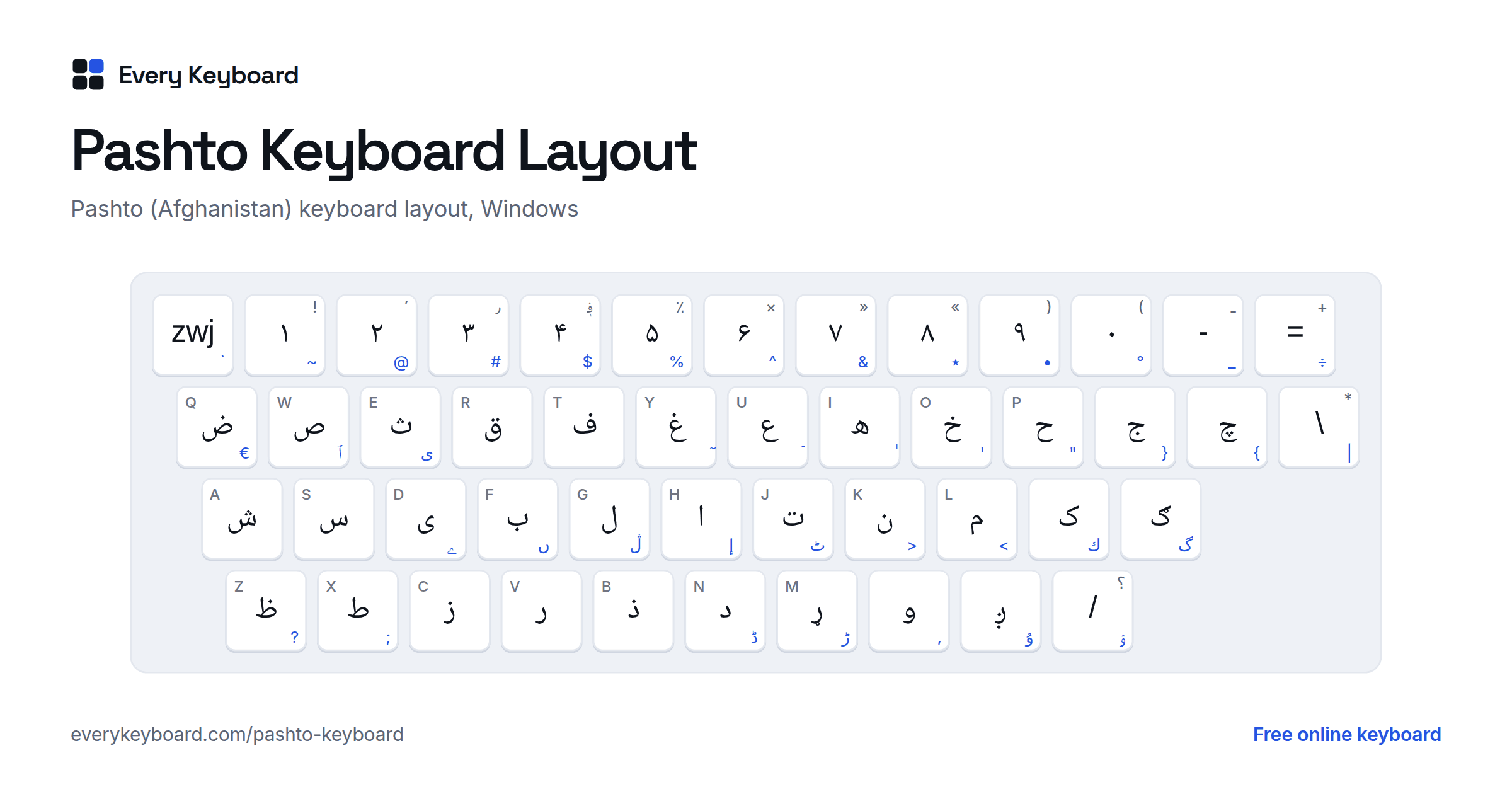
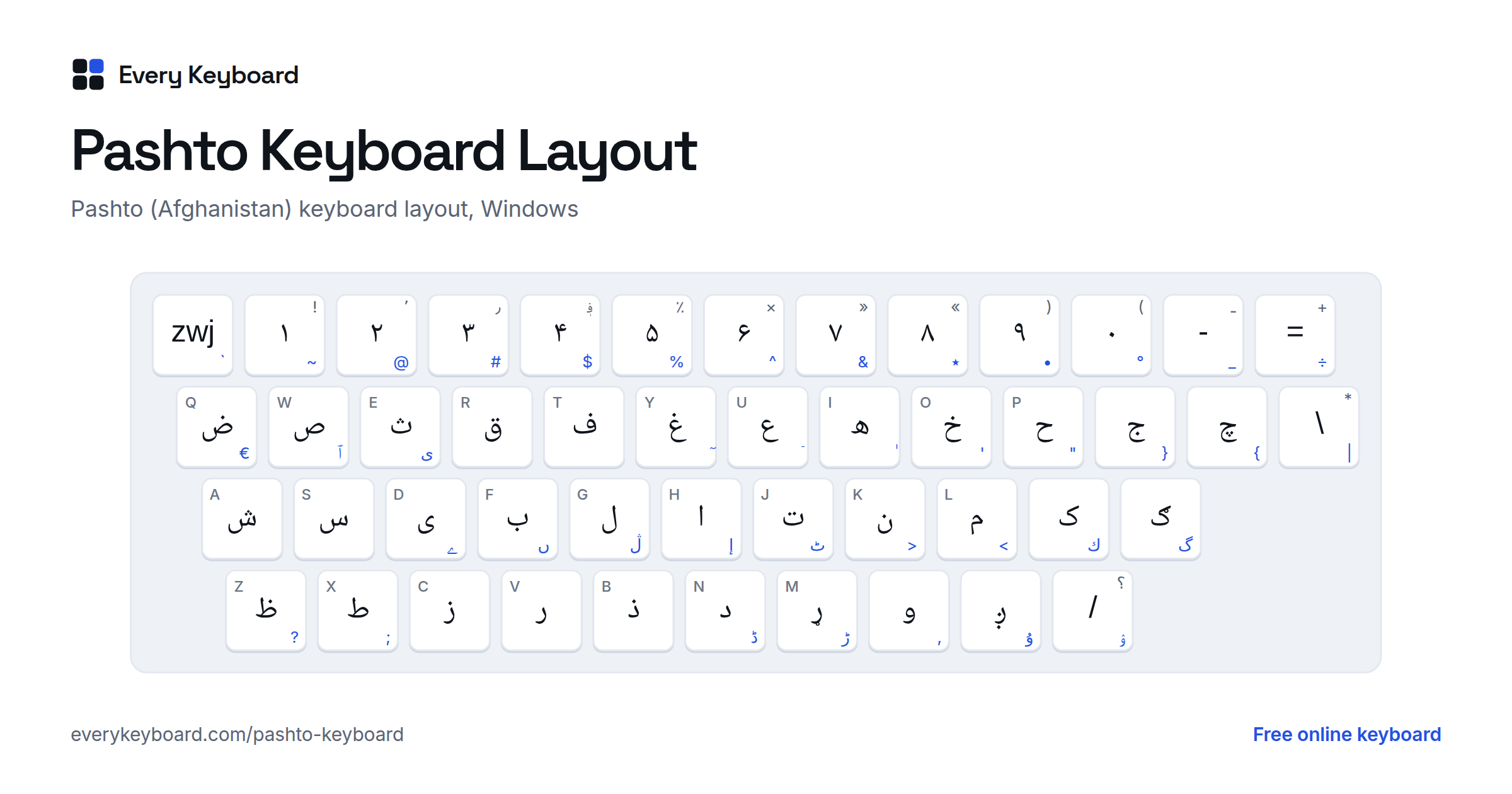
This is Windows' Pashto (Afghanistan) layout. The small letter on each key is the English key it shares, and the blue symbol is what AltGr (right Alt) adds. The number row types Pashto digits. The key left of 1 types an invisible zero width joiner (ZWJ).
With Shift held you get most of the letters only Pashto uses (ځ څ ښ ۍ ټ ڼ ئ ې ډ), the vowel marks on the top row, آ پ ژ ء and the punctuation. Shift+B is the zero width non-joiner (ZWNJ), which stops two letters from joining.
Windows also puts a left-to-right mark and a right-to-left mark on AltGr+R and AltGr+T, and a no-break space on AltGr+Space. They are invisible, so this page leaves them out.
Pashto phonetic keyboard layout
The phonetic layout is for typing Pashto on an English keyboard without learning the standard layout. Letters go on the English key with the same sound, and Shift gives the related Pashto letter. Letters used mostly in Arabic loanwords sit on V, [ and ]. The number row types Pashto digits, and Shift plus a number types a Western digit.
The Pashto alphabet
Pashto is written right to left in an extended Arabic script, usually in the Naskh style. It uses all 28 Arabic letters, the Persian letters پ چ ژ, and letters of its own for sounds Arabic and Persian don't have. It is usually counted as 44 or 45 letters, depending on whether hamza is included. The highlighted letters, marked Pashto only, are not used in Arabic, Persian or Urdu.
| Letter | Name | Sound | Latin | Standard key | Phonetic key |
|---|---|---|---|---|---|
| ا | alif | a as in father; also carries a vowel at the start of a word | a, ā | H | A |
| آ | alif madda | long ā at the start of a word | ā | Shift+H | Shift+A |
| ب | be | b | b | F | B |
| پ | pe | p | p | Shift+F | P |
| ت | te | soft t, tongue on the teeth | t | J | T |
| ټ | ṭe (Pashto only) | hard t, tongue curled back (retroflex) | ṭ | Shift+J | Shift+T |
| ث | se | s (in Arabic loanwords) | s | E | V |
| ج | jim | j as in jam | j | [ | J |
| ځ | dze (Pashto only) | dz as in adze; z in much of the north | dz | Shift+O | Shift+J |
| چ | che | ch as in chair | ch | ] | C |
| څ | tse (Pashto only) | ts as in cats; s in much of the north | ts | Shift+P | Shift+C |
| ح | he | h (in Arabic loanwords) | h | P | Shift+H |
| خ | khe | ch as in Scottish loch | kh | O | Shift+K |
| د | dal | soft d, tongue on the teeth | d | N | D |
| ډ | ḍal (Pashto only) | hard d, tongue curled back (retroflex) | ḍ | Shift+N | Shift+D |
| ذ | zal | z (in Arabic loanwords) | z | B | Shift+V |
| ر | re | tapped or rolled r | r | V | R |
| ړ | ṛe (Pashto only) | a flap with the tongue curled back, between r, l and d | ṛ | M | Shift+R |
| ز | ze | z | z | C | Z |
| ژ | zhe | s as in measure | zh | Shift+C | Shift+Z |
| ږ | ǵe (gāy) (Pashto only) | zh with the tongue curled back in the south; g in the north | ǵ, ẓ̌ | . | Shift+X |
| س | sin | s | s | S | S |
| ش | shin | sh as in shop | sh | A | Shift+S |
| ښ | x̌in (Pashto only) | sh with the tongue curled back in the south; kh in the north | x̌, ṣ̌ | Shift+A | X |
| ص | swad | s (in Arabic loanwords) | s | W | [ |
| ض | zwad | z (in Arabic loanwords) | z | Q | Shift+[ |
| ط | twe | t (in Arabic loanwords) | t | X | ] |
| ظ | zwe | z (in Arabic loanwords) | z | Z | Shift+] |
| ع | ayn | usually silent, or a slight catch (in Arabic loanwords) | ʿ | U | Shift+E |
| غ | ghayn | like a French r, made in the throat | gh | Y | Shift+G |
| ف | fe | f (in loanwords; many speakers say p) | f | T | F |
| ق | qaf | a k made further back in the throat; often just k | q | R | Q |
| ک | kaf | k | k | ; | K |
| ګ | gaf (Pashto only) | g as in go | g | ' | G |
| ل | lam | l | l | G | L |
| م | mim | m | m | L | M |
| ن | nun | n | n | K | N |
| ڼ | ṇun (Pashto only) | n with the tongue curled back (retroflex) | ṇ | Shift+K | Shift+N |
| و | waw | w, or the vowels u and o | w, u, o | , | W |
| ه | he | h; at the end of a word, a or ə | h, a, ə | I | H |
| ی | nārína ye (masculine ye) | y; ay at the end of a word, as in سړی (saṛay, man) | y, ay | D | Y |
| ي | tsərgánda ye | y; i at the end of a word, as in سړي (saṛi, men) | y, i | Shift+D | I |
| ې | úǵda ye (long ye) (Pashto only) | e as in café | e | Shift+X | E |
| ۍ | x̌əźína ye (feminine ye) (Pashto only) | əy at the end of feminine words, as in ډوډۍ (ḍoḍəy, bread) | əy | Shift+S | Shift+Y |
| ئ | fāʿilí ye (verbal ye) | əy at the end of verb forms (you, plural); also a hamza seat | əy | Shift+Z | Shift+' |
| ء | hamza | a glottal stop that separates two vowels | ʾ | Shift+V | ' |
Pashto writes most short vowels only in teaching texts. The ə sound, very common in Pashto, is often left unwritten inside a word and written with ه at the end.
How ښ and ږ are said: Kandahari and Yousafzai
The spelling is the same across Pashto, but two letters are said very differently in the south and in the north:
- Southern Pashto (Kandahari): ښ is a sh with the tongue curled back and ږ is a zh with the tongue curled back. The language پښتو is Pashto and a speaker is a Pashtun.
- Northern Pashto (Yousafzai), spoken in Mardan, Swabi and Swat, and also in Peshawar: ښ is said like kh and ږ like g. The same word is Pakhto, and a speaker is a Pakhtun. Six, شپږ, is shpaẓ̌ in Kandahar and shpag in Peshawar.
Some central dialects say ښ like the ch in German ich and ږ like a y. Many Yousafzai speakers also say څ as s and ځ as z. Whichever way you say them, you type the same letters.
Vowel marks
Type the letter first, then the mark. All of them are under Vowel marks on the keyboard.
| Example | Name | Use | Standard key | Phonetic key |
|---|---|---|---|---|
| بَ | Zwar | short a | Shift+U | ` (left of 1) |
| بٙ | Zwarakay | ə, the short a in about | AltGr+U | Shift+` |
| بِ | Zer | short i | Shift+Y | Shift+I |
| بُ | Pekh (pesh) | short u | Shift+T | Shift+U |
| بْ | Jazm (sukun) | no vowel after the letter | Shift+Q | Shift+Q |
| بّ | Shadda | doubles the letter | Shift+I | Shift+W |
| بً | Tanwin | -an, in Arabic words like فوراً | Shift+R | |
| بٔ | Hamza above | a glottal stop or a vowel break | Shift+` |
Pashto numbers ۰ to ۹
In Afghanistan Pashto is usually written with the Eastern Arabic digits below (the same shapes as in Persian). In Pakistan, Western digits (0 to 9) are also common. Both keyboard layouts on this page type these digits from the number row; the Alphabet tab has them too.
| Digit | Value | Word | Say |
|---|---|---|---|
| ۰ | 0 | صفر | sifr |
| ۱ | 1 | یو | yaw |
| ۲ | 2 | دوه | dwa |
| ۳ | 3 | درې | dre |
| ۴ | 4 | څلور | tsalór |
| ۵ | 5 | پنځه | pindzə |
| ۶ | 6 | شپږ | shpaẓ̌ (south), shpag (north) |
| ۷ | 7 | اووه | owə |
| ۸ | 8 | اته | atə |
| ۹ | 9 | نهه | nəhə |
| ۱۰ | 10 | لس | las |
Pashto punctuation: the comma is ،, the question mark ؟, the semicolon ؛, and quotes are written « ». The full stop is a normal period. The digits on this page are the characters ۰۱۲۳۴۵۶۷۸۹ (U+06F0 to U+06F9).
How to add a Pashto keyboard to your device
Windows
Settings → Time & language → Language & region → Add a language → Pashto. The keyboard it adds is Pashto (Afghanistan), the standard layout shown above. Switch with Windows+Space or Alt+Shift.
Mac
System Settings → Keyboard → Text Input → Edit → +, then search for Pashto. The Mac layout is not the same as the Windows one, so keys may differ from the diagrams on this page. Switch with Control+Space or the Globe key.
iPhone and iPad
Settings → General → Keyboard → Keyboards → Add New Keyboard → Pashto. Tap the globe key to switch.
Android (Gboard)
Open the Gboard app (or Settings → System → Languages & input → On-screen keyboard → Gboard), then Languages → Add keyboard → Pashto. Tap the globe key or hold the space bar to switch languages.
Chromebook
Settings → Device → Keyboard and inputs → Input settings → Add input methods, then search for Pashto. If your Chromebook doesn't list it, you can type on this page and copy the text, or use Gboard from the Play Store if your Chromebook runs Android apps.
Frequently asked questions
How do I type Pashto with an English keyboard?
Pick the Phonetic tab on the keyboard. Each English key types the Pashto letter that sounds like it (B → ب, P → پ, K → ک, G → ګ), and Shift gives a related letter (T → ټ, D → ډ, R → ړ, N → ڼ). Type, then press Copy and paste your text anywhere.
Where are ټ ډ ړ ڼ ښ ږ څ ځ on the standard Pashto keyboard?
On the Windows Pashto layout: Shift+J is ټ, Shift+N is ډ, M is ړ, Shift+K is ڼ, Shift+A is ښ, the period key is ږ, Shift+P is څ and Shift+O is ځ. ګ is on the ' key, ې is Shift+X and ۍ is Shift+S.
Which ye do I use: ی ي ې ۍ or ئ?
They are different letters in Pashto. ی ends words in ay (سړی, man), ي ends words in i (سړي, men), ې is the e sound, ۍ is əy at the end of feminine words (ډوډۍ) and ئ is əy at the end of verb forms. Mixing them up can change the meaning, so each has its own key.
Why does my ګ look different from گ?
Pashto writes g as ګ, a kaf with a small ring below. Persian and Urdu use گ, with a second stroke on top. They are different characters, so words typed with the wrong one won't match in search. This keyboard types the Pashto ګ; on Windows, AltGr+' types the Persian گ.
Can I type Pashto on my phone?
Yes. Gboard on Android and the built-in iPhone and iPad keyboard both have Pashto. See the steps above. You can also use this page on your phone: tap the keys, then copy your text.
Is my text private?
Yes. Everything runs in your browser and your draft is kept on your own device so it survives a refresh. Nothing is uploaded.